Serving Savannah, GA & Austin TX


Mon - Sunday: 8am- 8pm


Protecting floors and walls during a move comes down to three things: covering the surfaces most likely to get hit, padding the corners and door frames furniture tends to catch on, and planning your route before anyone starts carrying boxes. Scuffed hardwood, dented drywall, and torn carpet are some of the most common and most avoidable casualties of moving day, and most of the damage happens in the first hour when everyone is still figuring out the best path from the truck to the front door.
If you are planning a full household relocation, this is one of those details that is easy to overlook until you are staring at a gouge in your baseboard. Below is a practical, room-by-room approach to keeping your old home (or your new one) looking the way it did before moving day started.
Floors and walls usually get damaged because heavy furniture is dragged instead of lifted, hallways and doorways are narrower than the items passing through them, and nobody has mapped out the route in advance. Add tired arms, a tight timeline, and a staircase, and small mistakes turn into dents, scratches, and scuffed paint.
Most damage is not caused by one dramatic accident. It is the accumulation of small impacts: a dresser corner brushing a doorframe, a box spring scraping a stair rail, a dolly wheel rolling over an unprotected rug. Knowing where these impacts typically happen is the first step to preventing them.
The most effective way to protect hardwood and tile floors is to cover the main walking path with heavy-duty floor runners or moving blankets, and to use furniture sliders under any piece that cannot be lifted completely off the ground. This prevents scratches from dragging and reduces the risk of cracked tile from dropped weight.
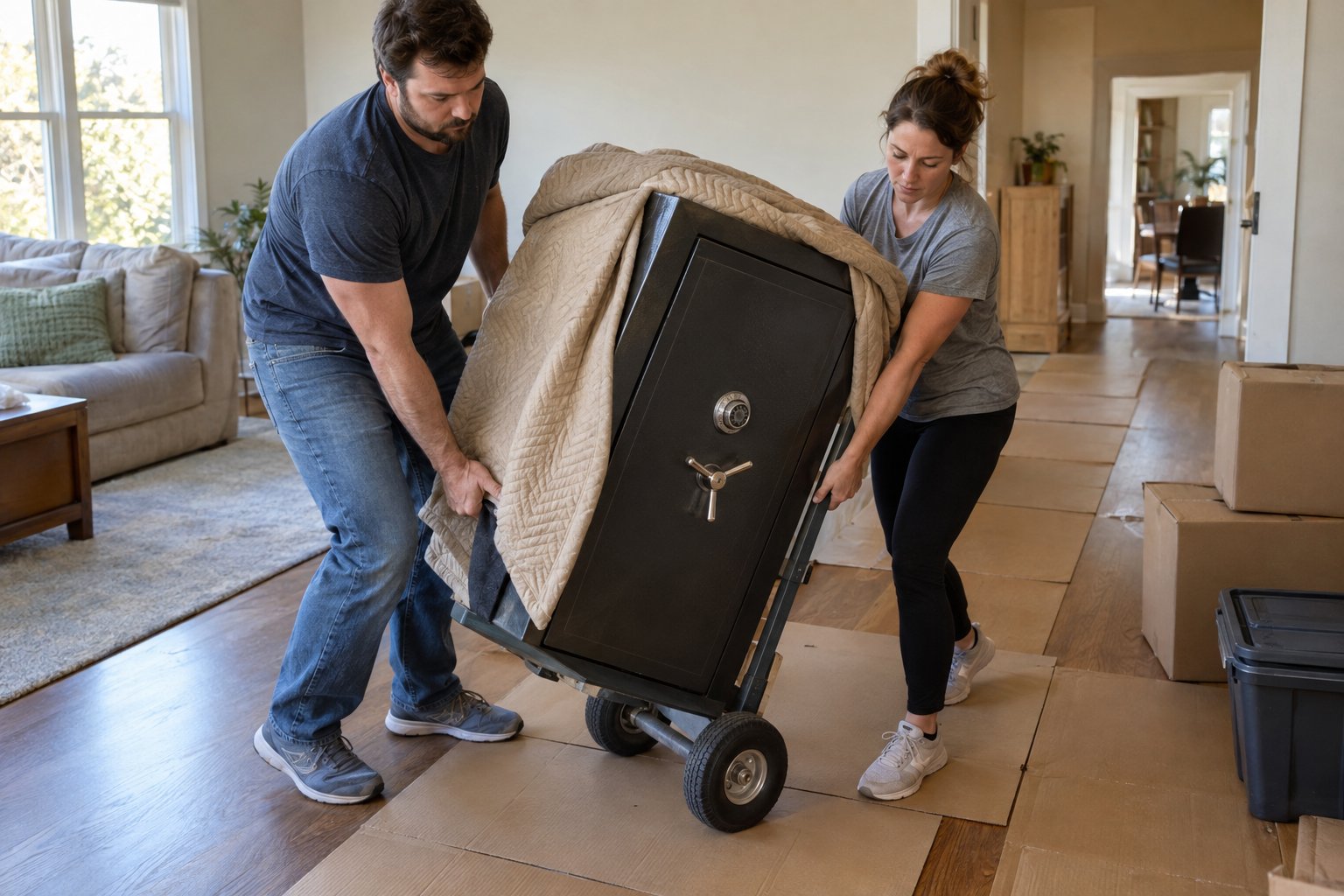
Before loading day, lay down a continuous path of protective covering from the farthest room to the exit. Ram board, red rosin paper, or canvas drop cloths all work, and you can tape the seams so the covering does not shift underfoot. For furniture with legs or a flat base, furniture sliders let a mover pivot a heavy dresser or couch without grinding its feet into the finish. Avoid pushing anything on bare floors, even for a few feet. That short drag is usually where the worst scratches happen.
On tile, pay extra attention to grout lines and any sections that already have hairline cracks. A dropped box of books can chip tile in a way that is difficult to repair invisibly.
Carpet is protected by covering traffic areas with plastic film or carpet shield adhesive runners, which keep dolly wheels and shoe traffic from grinding in dirt and leaving permanent compression marks. For heavy furniture that will sit in one spot for hours before loading, furniture coasters placed under the legs prevent deep indentations.
Carpet shield rolls with a sticky underside are inexpensive and stay in place far better than plastic sheeting taped down with painter's tape. If you are short on budget, even old bedsheets or towels along the main path reduce friction and catch loose debris tracked in from outside. Pay attention to stairs covered in carpet. They take the heaviest wear because every box and piece of furniture crosses them at an angle, which is exactly when dolly wheels tend to slip sideways and tear fibers.
Walls and door frames stay undamaged when corners are padded, doorways are measured before furniture goes through them, and large items are tilted or disassembled rather than forced through a tight gap. Foam corner guards on doorframes and stair rails absorb the impact from a couch arm or dresser edge that misjudges the turn.
Walk the route with a tape measure before moving day and identify any doorway, stairwell turn, or hallway corner narrower than your largest furniture piece. For those spots, plan to remove doors from their hinges temporarily, take off couch legs, or tilt mattresses on their side. A roll of painter's tape and some cardboard sheeting over switch plates and light fixtures near the moving path also prevents accidental knocks that chip paint or crack a plate.
Stairwells deserve special attention because turns are tight and visibility is limited for whoever is walking backward. Having one person call out turns while another guides the furniture reduces the odds of a wall getting clipped.
A basic home protection kit includes moving blankets, floor runners or ram board, furniture sliders, corner and door frame guards, carpet shield film, and painter's tape. Most of these items are reusable, so they are worth buying even for a single move rather than relying on bedsheets and improvisation.
Stock up before moving day rather than during it. Running out of floor covering halfway through loading the truck means the back half of the move happens on bare, unprotected flooring. If you are not sure how much you need, measure your main hallways and stairwells and buy enough runner material to cover the full path in one continuous piece.
Hiring professional movers reduces the risk of property damage because trained crews know how to carry furniture through tight spaces, use the right equipment for each surface, and move as a coordinated team instead of individually guessing the safest path. This matters most in older homes, homes with narrow stairwells, or moves where floors and walls are freshly finished.
DIY moves with family and friends are often where the most floor and wall damage happens, not because people are careless, but because they are not used to carrying heavy, awkward items as a team. If protecting your home's finishes is a priority, working with professional residential moving services is worth considering, since trained crews bring their own padding, blankets, and floor protection as standard practice. For moves into a new build or a recently renovated space, residential moving labor services can also help if you just need extra hands for the heavy lifting and furniture placement without a full-service move.
The best way to protect your floors and walls is to treat it as a planning task, not an afterthought. Walk the route, measure the tight spots, lay down protection before the first box leaves the house, and make sure everyone helping understands the plan. A move that takes an extra 30 minutes to set up protection is still faster than one that ends with a trip to the hardware store for wall patch and floor touch-up kits.
If your move involves specialty pieces that need extra care getting through doorways, the team behind specialty moving services can offer guidance on handling oversized or awkward items without putting your home's surfaces at risk. And whenever you are ready to plan the logistics of your move in Savannah, you can get a moving quote to talk through your home's layout and any protection concerns ahead of time.
BC Brothers Moving & Storage is a locally owned, licensed and insured moving company rated 4.9 stars across 800+ reviews. Residential, commercial, long-distance, packing and storage — handled by one crew.
Movers in Savannah·Residential Moving·Packing Services·Long-Distance Moving·Storage