Serving Savannah, GA & Austin TX

.png)
Mon - Sunday: 8am- 8pm

.svg)
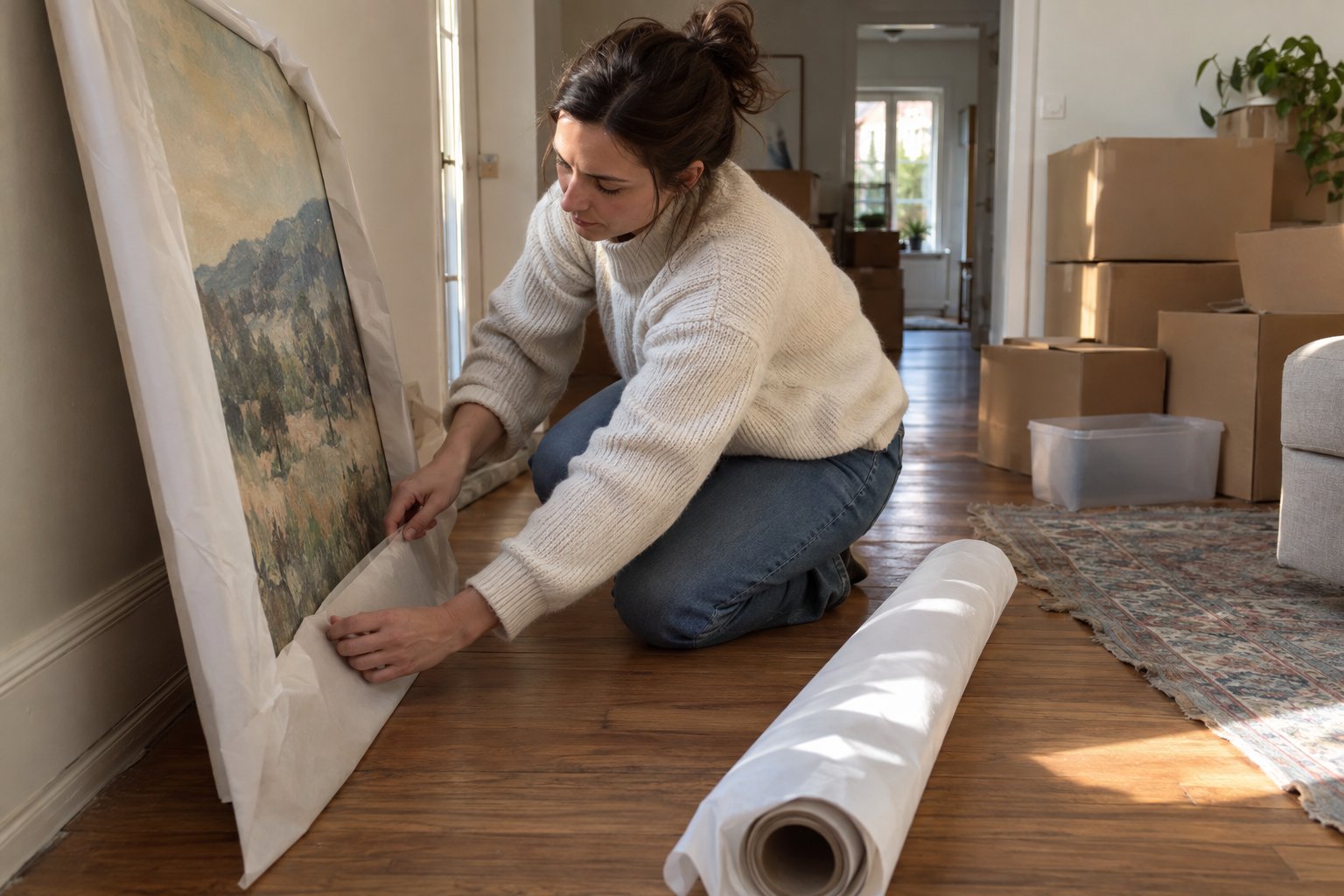
Packing canvas art for moving means protecting the surface from punctures, the stretcher bars from warping, and the corners from the kind of hard knock that cracks paint. Canvas is deceptively fragile: it looks sturdy rolled up in a storage closet, but a flat canvas with nothing covering its face can be dented by a single box pressed against it in a moving truck. Get the layering right before the truck doors close and a painting that survived years on your wall will survive the move too.
You pack canvas art by keeping a layer of air between the painted surface and anything that touches it, then boxing it so the frame corners absorb any impact instead of the canvas face. Never let bubble wrap, paper, or plastic sit directly against painted canvas, since moisture and texture can transfer onto the surface over time, especially on pieces that are not fully cured or varnished.
Start by covering the face of the painting with a sheet of clean glassine paper or acid-free tissue paper. This creates a barrier that will not stick to the paint even if the canvas was finished recently. Over that, add a layer of bubble wrap with the bubbles facing out, away from the canvas, so the cushioning absorbs shock without pressing texture into the surface.
A properly packed canvas needs corner protectors, glassine or acid-free paper, bubble wrap, a mirror or picture box, and packing tape, in that order of importance. Skipping the corner protectors is the most common mistake, since corners are where frames take the hardest hits when boxes shift in transit.
Large canvas paintings need to travel upright, never flat, and should never bear the weight of anything stacked on top. A big canvas laid flat under other boxes is one of the fastest ways to warp stretcher bars or cause the canvas to sag away from its frame.
For oversized pieces that will not fit a standard picture box, build a simple plywood crate or sandwich the painting between two sheets of cardboard cut larger than the frame, taped around the edges to form a rigid shell. Stand the piece on its edge inside the vehicle, wedged against a wall or other upright furniture so it cannot tip, and never lay another item against the face even with padding in between. If you are moving several large paintings at once, consider whether a specialty moving services team should handle the transport, since they carry the crating materials and securing straps built for oversized flat items.
In most cases, no. Keeping the canvas attached to its frame or stretcher bars actually protects it, since the frame maintains tension on the canvas and gives you something rigid to grip instead of handling the painted surface directly. Only remove a painting from its frame if the frame itself is already damaged or if a conservator has advised it for a specific piece.
When you have more than a few pieces, pack similar sizes together in the same box using cardboard dividers between each painting, never canvas against canvas without a buffer. A stack of paintings packed face to face without separators is how corners dig into neighboring canvases during transit.
Group paintings by size so smaller pieces are not sliding around in an oversized box, and always place the heaviest, most sturdily framed pieces at the outer edges with lighter or more delicate works protected in the middle. Keep an inventory list taped to the outside of each box noting how many pieces are inside and their approximate value, which also helps if you need to file a claim. If your move involves a full household of breakables alongside the art, pairing this with professional packing services can save you from juggling glassware, electronics, and framed pieces all at once.
Art boxes belong in the truck last, loaded standing upright against a flat wall of the cargo area, never flat on the floor where other items can be stacked on top. Treat every picture box as the final layer of the load, not something to wedge into gaps between furniture.
Label each box clearly on all sides, not just the top, since boxes get turned and shuffled during loading. If you are driving the load yourself, strap art boxes to the wall of the truck or van using ratchet straps so sudden stops do not send them sliding into other cargo. For a long-distance relocation where the truck will be loaded and unloaded multiple times, ask your long distance moving services provider how they section off fragile items so your paintings are not repositioned at every stop.
If you own original paintings, gallery pieces, or anything with real sentimental or appraised value, professional handling is worth the conversation even if you are packing everything else yourself. Movers who regularly handle fragile and specialty items know how to crate oversized canvases, secure them against movement, and document condition before transport.
A quick call to request a written quote will tell you whether specialty crating makes sense for your collection, especially if you are also moving other delicate items like mirrors, glass tabletops, or electronics in the same trip. Get a moving quote to find out what fragile-item protection looks like for your specific move.
BC Brothers Moving & Storage is a locally owned, licensed and insured moving company rated 4.9 stars across 800+ reviews. Residential, commercial, long-distance, packing and storage — handled by one crew.
Movers in Savannah·Residential Moving·Packing Services·Long-Distance Moving·Storage

.svg)


.svg)
.svg)