Serving Savannah, GA & Austin TX

.png)
Mon - Sunday: 8am- 8pm

.svg)
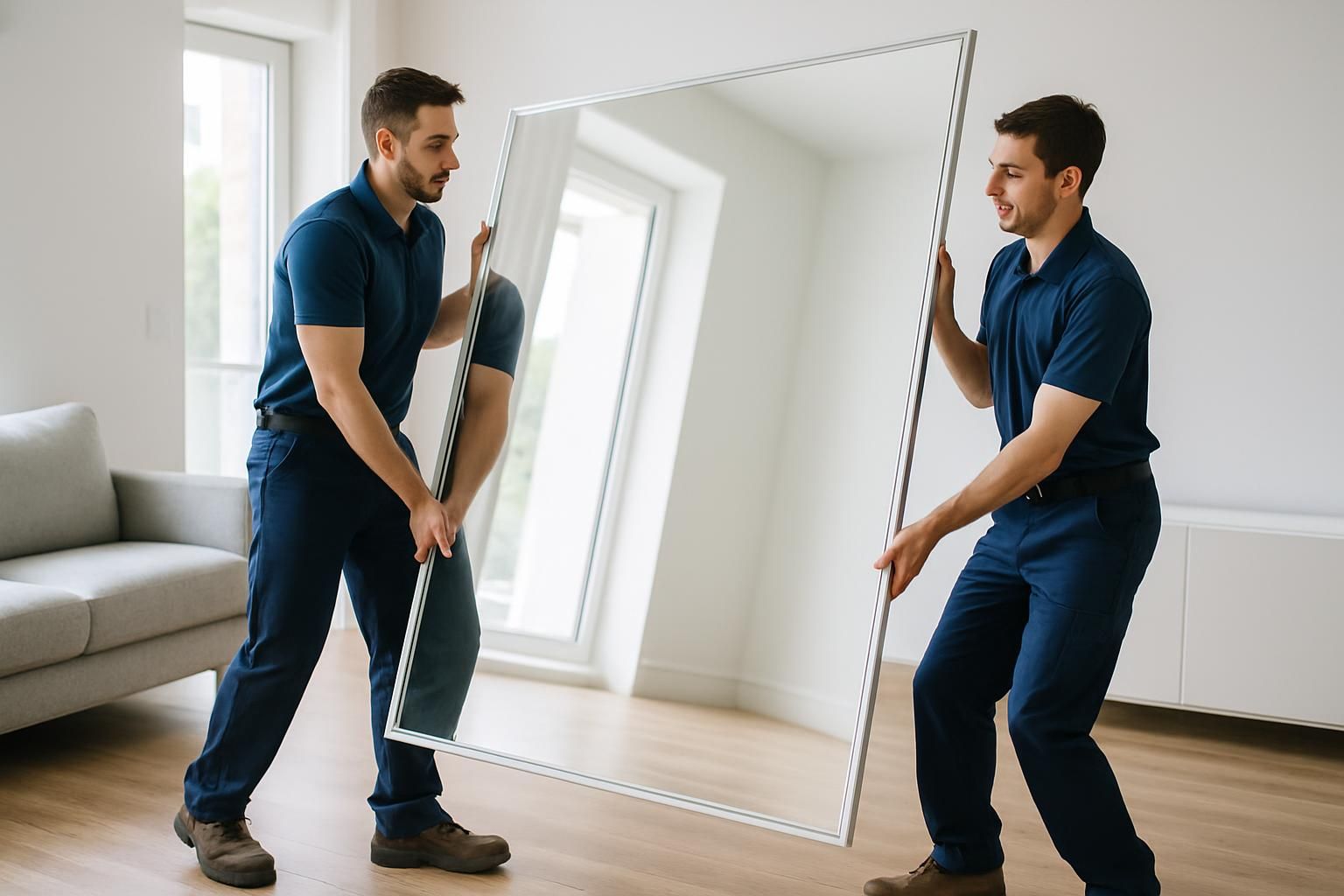
Moving a large mirror safely comes down to three things: keeping pressure off the glass, protecting the corners where cracks start, and transporting it on edge rather than flat. A full-length or oversized wall mirror does not fail because of one big impact. It fails because of flex, a little bit of bending in the glass under its own weight, that eventually finds a stress point and splits. Once you understand that, the packing and loading choices make a lot more sense.
Mirrors are some of the most commonly damaged items in a home move, right alongside glass tabletops and framed art. They are heavy, they are awkward to grip, and there is no way to hide a crack once it happens. Here is how to move a large mirror the right way, from the materials you need to how it should ride in the truck.
You need cardboard corner protectors, packing paper or moving blankets, painter's tape (never regular tape directly on the frame or glass), a mirror box if the size allows for one, and a way to carry it upright with two people. Skipping any one of these is how mirrors end up cracked in transit, not because of a dramatic drop but from slow flex over a bumpy ride.
For anything wider than about three feet, a rigid stretch wrap layer over the padding helps keep everything compressed and immobile, which matters more for mirrors than for most furniture. Painter's tape in an X pattern across the glass face is optional but worth doing for older or already-thin mirrors, since it keeps shards contained if the worst happens and adds a small amount of resistance to flex.
Wrap a mirror by covering the glass face first with a layer of packing paper or a thin moving blanket, then applying cardboard corner protectors to all four corners, then wrapping the entire piece in a heavier blanket secured with stretch wrap or tape. The corners are the priority. That is where nearly all mirror breaks originate, since a corner impact concentrates force into a small area of glass instead of spreading it across the frame.
If you have the original packaging or foam corner brackets, use them. If not, cut squares of thick cardboard, fold them over each corner, and tape them in place before adding the outer wrap. For mirrors with an ornate or wooden frame, add an extra layer of padding along the frame edges too, since chipped wood or a bent metal frame is a common secondary casualty even when the glass survives.
A mirror box, a flat telescoping cardboard box built specifically for glass and framed art, is worth it for any mirror you cannot easily replace or any move longer than a short local trip. The box adds a rigid outer shell that resists bending, which is the main failure mode for an unboxed mirror stacked or shifted during transport. For a quick move of a small or mid-size mirror, careful wrapping without a box can work, but boxing is the safer default.
A mirror should always travel on its edge, never flat, and never with anything stacked on top of it. Loading it flat lets the full surface bear weight it was not built to hold, and even a light box on top can be enough to crack it over a few hours of road vibration. Standing it on edge lets the frame, which is far more rigid than the glass, carry the load instead.
Position the mirror against a wall of the truck or between other soft, flat items like mattresses, using rope or straps to keep it from sliding or tipping during turns and stops. Avoid wedging it next to anything with sharp edges or hardware that could poke through the padding. If you are moving several mirrors or framed pieces at once, load them side by side on edge rather than stacked, even if that costs more space in the truck.
Carry a large mirror with two people, one on each side, gripping the frame rather than the glass, and keep it vertical the entire time it is in motion. Never carry a mirror flat with one hand under the middle. That is where flex-related cracking most often starts, sometimes hours after the move when nobody would connect it back to the carry.
Hiring professional help makes sense when the mirror is oversized, antique, custom-framed, or simply too valuable to risk on a DIY carry down stairs or through tight doorways. A crew that handles fragile items regularly will have mirror boxes, proper padding, and the technique to move a large piece of glass without the flex that causes cracks. For everything else, careful wrapping and an extra set of hands are usually enough.
If your move includes multiple large mirrors, glass furniture, or other specialty items, it can be worth bundling that work into professional specialty moving services rather than handling each piece separately. It also frees you up to focus on the rest of the packing timeline instead of worrying about one fragile item riding safely across town.
Most mirror damage traces back to one of a few repeatable mistakes: taping directly onto the glass or frame finish, transporting the mirror flat, stacking items on top of it, or leaving corners unprotected. Any one of these is enough on its own, and moves that combine two or three of them are where the majority of cracked mirrors come from.
Another overlooked mistake is packing a mirror too early and then leaving it leaning unsecured in a garage or hallway for days before the move. A mirror that gets bumped while just sitting around is just as likely to crack as one mishandled during loading, so treat the staging area with the same care as the truck itself.
If you are working through a full room-by-room plan and want the wrapping techniques for other fragile items, our guide on wrapping furniture for moving covers the padding and taping approach for wood and upholstered pieces, which pairs well with the glass-specific steps above. And if you would rather not manage the fragile items yourself, you can always get a moving quote from our Savannah team.
BC Brothers Moving & Storage is a locally owned, licensed and insured moving company rated 4.9 stars across 800+ reviews. Residential, commercial, long-distance, packing and storage — handled by one crew.
Movers in Savannah·Residential Moving·Packing Services·Long-Distance Moving·Storage

.svg)



.svg)
.svg)