Serving Savannah, GA & Austin TX

.png)
Mon - Sunday: 8am- 8pm

.svg)

If you have ever moved with a large book collection, you already know the challenge. Knowing how to pack books correctly is one of those skills that sounds simple until you are standing in front of three packed bookshelves wondering where to begin. Books are heavier than most people expect, and they are easy to damage when they are not packed with a little care and intention. Getting this part of your move right protects your collection and makes unpacking a much more manageable experience, especially when preparing for a move with the help of professional residential moving services.
Books seem like straightforward items to pack. They are rectangular, they stack, and they do not shatter. But that simplicity is deceptive. Books are surprisingly heavy when grouped together, and a single overfilled box can weigh enough to cause serious strain or collapse entirely before it reaches the truck. Treating your book packing as its own task rather than an afterthought is always the right call.
Beyond the weight issue, books are vulnerable to moisture, pressure, and bending in ways that cause permanent damage. A spine that gets twisted under the weight of other items may never fully recover. Pages that get damp can wrinkle or stick together. A little intentional packing goes a long way toward keeping every book in the same condition it was in when it came off the shelf.
This is especially true for rare, signed, or sentimental books. Even if most of your collection is paperback and replaceable, the books that matter most to you deserve extra care. A few minutes of thoughtful packing at the start saves a great deal of regret later.
Box selection is where a lot of people go wrong when packing books for a move. The instinct is to reach for the largest box available and fill it up. For books, that approach almost always creates a box that is too heavy to carry safely and too prone to structural failure under the load.
Small and medium boxes are almost always the better choice for books. A small box filled with books is a manageable weight. A large box filled even halfway with hardcovers can easily exceed a safe lifting limit and becomes a genuine hazard on moving day. The goal is a box that feels solid and controlled when you pick it up, not one that requires two people just to shift from the floor.
If you have access to specialty book boxes, those are worth using for larger or more valuable collections. They are designed with reinforced construction and appropriate dimensions for the weight of books. If you are sourcing standard moving boxes, double-stacking the bottom of each box with an extra layer of cardboard adds meaningful structural support before you place the first book inside.
Once you have the right box, the way you orient your books inside it makes a real difference in both protection and weight distribution. There are three main approaches, and each has its appropriate use depending on the type of book and the space available.
Packing books spine down, with pages facing up, is one of the most protective methods for hardcovers. It distributes the weight evenly across the strongest part of the binding. Laying books flat in horizontal stacks is also reliable and works well for oversized or coffee table books that do not fit comfortably in vertical arrangements. Packing books spine up with pages facing down is generally the least recommended method because it puts pressure on the page edges and can cause bending over time.
What you want to avoid in every case is packing books spine out against the side of a box with nothing supporting them. Books shift during transport, and an unsupported spine takes the full force of that movement. A little padding along the sides of the box using packing paper or soft fabric fills that gap and keeps everything in place.
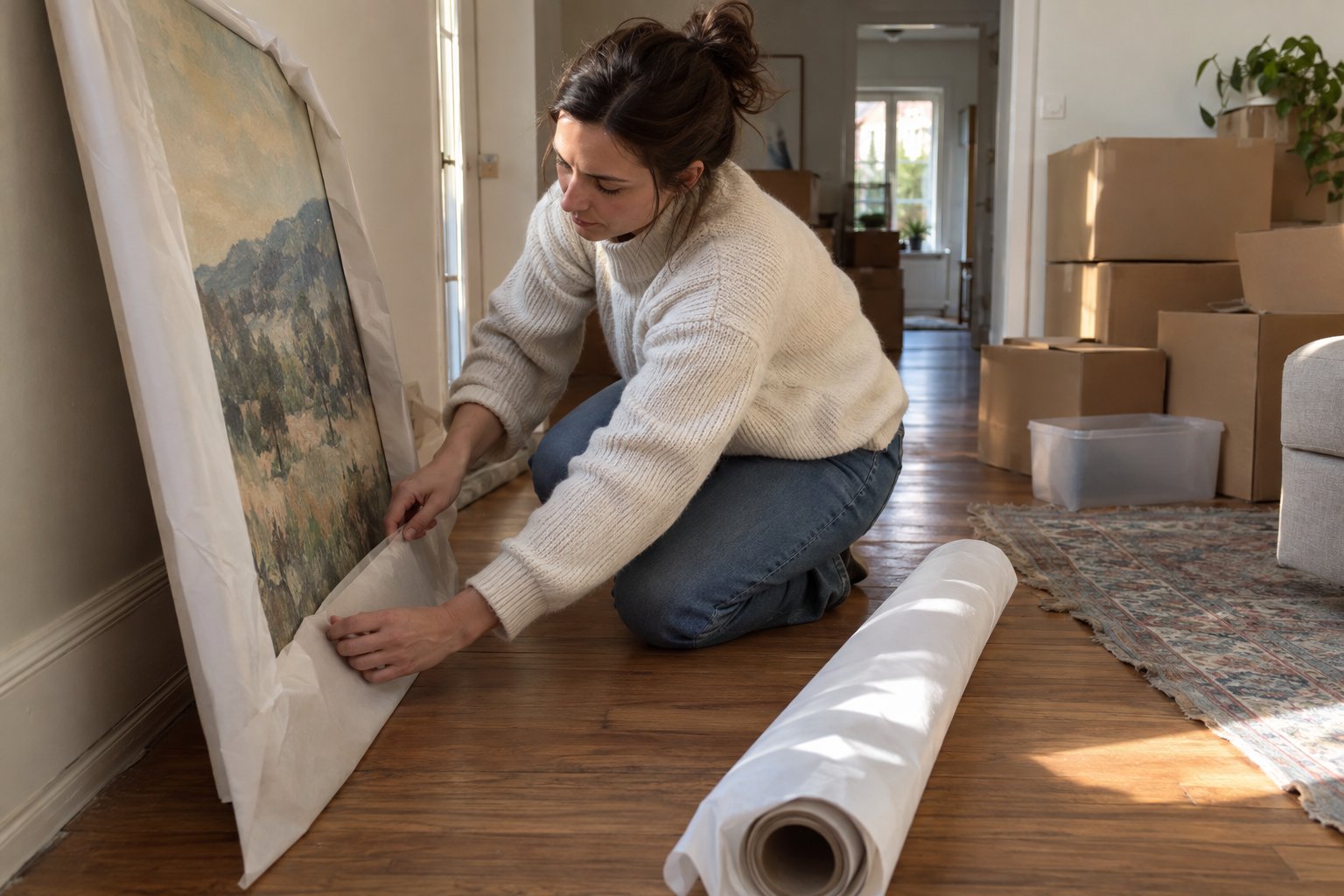
Not every book in your collection needs individual wrapping, but the ones that matter most do. For rare editions, signed copies, or books with delicate covers, wrapping each one individually in packing paper or acid-free tissue before placing it in the box adds a layer of protection that is well worth the extra few minutes per item.
For books with dust jackets, consider removing the jacket and wrapping it separately. Dust jackets are thin and prone to tearing or creasing when they get caught against other items in the box. Folding each jacket flat and tucking it inside the front cover of the corresponding book keeps it intact without adding bulk.
Hardcovers with embossed or foil covers benefit from a layer of tissue paper or soft packing material between them to prevent the surfaces from pressing against each other. Over the course of a move, friction between decorative covers can cause scuffing that is difficult to fully reverse. When you have items that require this level of care, professional specialty moving services for delicate and valuable items can help ensure they are handled and transported safely.
One of the most practical things you can do when packing books for a move is distribute weight thoughtfully across your boxes rather than organizing purely by category or size. It is tempting to pack all of your largest hardcovers together or to group an entire series into one box, but this often results in uneven weight distribution that makes certain boxes much harder to move than others.
A useful approach is to mix heavier and lighter books within the same box. A layer of heavy hardcovers followed by a layer of lighter paperbacks keeps the box at a manageable overall weight while still allowing you to organize by subject or author if that matters to you. Keeping each box under a specific weight ceiling, roughly thirty to forty pounds depending on who will be carrying them, sets a useful boundary for how much goes in each one.
Labeling each box clearly on the top and at least one side with the word BOOKS and a general note about the contents, such as the shelf or category they came from, makes unpacking far more efficient. It also signals to anyone helping you move that the box is dense and should be lifted with care.
If you are partway through packing your book collection and find yourself running short on packing paper or padding materials, household items work reasonably well as substitutes. Clean t-shirts, towels, and soft clothing items can be used to fill gaps around books inside a box and cushion the contents without any cost.
Newspaper is a widely available option for wrapping books, though it does carry a risk of ink transfer onto lighter-colored pages or covers over time. If you use newspaper, wrapping the book first in a layer of plain paper or tissue before the newspaper adds a barrier that prevents direct contact. This is a small step that matters for books with light-colored or glossy covers.
Bubble wrap is effective but better reserved for the most fragile or valuable items in your collection rather than applied broadly to every book. Its bulk can make boxes harder to close and leads to a lot of wasted space when used at volume. Strategic use of bubble wrap on the items that genuinely need it is more efficient than reaching for it as a default.
Some people pack books alongside other items, particularly when clearing out shelves that hold a mix of books, small decorative objects, and framed photographs. While this is not always ideal, it is manageable with the right approach. Books should go on the bottom of any mixed box, not on top of fragile items. Their weight and solid structure make them the best foundation layer for a box that contains more delicate things above.
If a mixed box contains anything breakable, make sure the books are wrapped or positioned so they cannot shift and press against the fragile items during transit. A single layer of packing paper or a folded towel between the book layer and anything above it provides enough of a buffer in most cases.
Avoid mixing books with anything wet, damp, or food-related regardless of how well sealed those other items may appear to be. Moisture is one of the most damaging things that can happen to a book in transit, and the risk is simply not worth it.
At BC Brothers, we have helped plenty of people move collections they have spent years building. Whether you are relocating locally or planning a larger move, our long-distance moving services ensure your belongings are handled with care from start to finish. If you are preparing for a move and want a team that handles every box with attention and professionalism, we are glad to help you figure out the details.
Reach out at (912) 658-5700 or send us a message at info@bcbrothersmoving.com whenever you are ready to talk.
How heavy should a box of books be?
Keep book boxes between 30 and 40 pounds when possible. Books are dense and a fully packed large box can easily exceed safe lifting limits. Use small or medium boxes and stop filling before the box becomes difficult to carry comfortably with both hands.
Should I pack hardcovers and paperbacks separately?
Not necessarily, but mixing them thoughtfully helps manage weight. Place heavier hardcovers at the bottom and lighter paperbacks on top. This keeps boxes balanced and reduces pressure on smaller books. Organizing by shelf or subject within that structure works well for most collections.
Can I pack books in a suitcase instead of boxes?
Yes, suitcases with wheels work well for books because the weight is easier to manage when rolling rather than lifting. Just make sure the suitcase closes fully and the contents are not shifting. Line the inside with a layer of packing paper to protect covers during transit.
How do I protect books from moisture during a move?
Keep book boxes off the floor of the truck if possible and away from exterior walls where condensation can form. Avoid packing books near anything damp. Wrapping individual books in plastic before boxing them adds meaningful protection during moves in wet or humid weather conditions.
Is it okay to pack books spine out against the box wall?
It is not ideal. When books are packed spine out with nothing supporting them, they shift during transit and the spine absorbs that pressure. Fill any gaps along the box walls with packing paper or soft fabric so books stay upright and supported throughout the entire move.
BC Brothers Moving & Storage is a locally owned, licensed and insured moving company rated 4.9 stars across 800+ reviews. Residential, commercial, long-distance, packing and storage — handled by one crew.
Movers in Savannah·Residential Moving·Packing Services·Long-Distance Moving·Storage

.svg)




.svg)
.svg)